Uncategorized

Now accepting applications for Early Intervention Specialist Program – for Birth to Three Providers

.

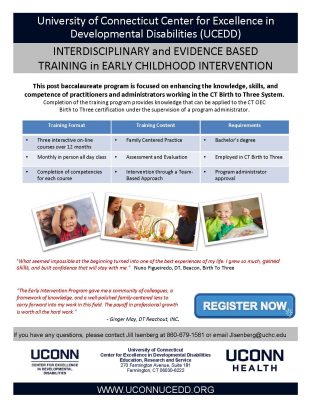
This post-baccalaureate program is focused on enhancing the knowledge, skills, and competence of practitioners and administrators working in the CT Birth to Three System. Completion of the training program provides knowledge that can be applied to the CT OEC Birth to Three certification under the supervision of a program administrator.

If you have any questions, please contact Jill Isenberg at 860-679-1561 or email JIsenberg@uchc.edu

Register now! 

EISP Flyer_final2026_link

The statewide rollout of Connecticut’s Yellow Envelope Program & Community Training Symposium

The statewide rollout of Connecticut’s Yellow Envelope Program & Community Training Symposium will be held on January 14, 2026, at the Legislative Office Building, Hearing Room 1A. This event will be from 2:00 PM to 4:00 PM, and is open to the public, but individuals with disabilities, disability rights or related advocacy organizations, first responders, and legislators are encouraged to attend. Limited seating is available, and registration is required, so please be sure to REGISTER! If you have any questions, please contact: TJ Nuccio at: thomas.nuccio@cga.ct.gov

Now accepting applications for Early Intervention Specialist Program – for Birth to Three Providers

This post-baccalaureate program is focused on enhancing the knowledge, skills, and competence of practitioners and administrators working in the CT Birth to Three System. Completion of the training program provides knowledge that can be applied to the CT OEC Birth to Three certification under the supervision of a program administrator.

If you have any questions, please contact Jill Isenberg at 860-679-1561 or email JIsenberg@uchc.edu

Register now! 

EISP Flyer_final2026_link


CT LEND Fellows Train to Improve Health Care for People with Developmental Disabilities

Three UConn School of Social Work MSW students are serving as 2025-26 Connecticut Leadership Education in Neurodevelopmental and Related Disabilities (CT LEND) Fellows, gaining interdisciplinary training to enhance health care delivery for individuals with neurodevelopmental disabilities and their families.
UConn Today
As CT LEND Fellows, Alison Fox, Quinn Meehan, and Grace Hartmann are completing more than 700 hours of coursework, research, advocacy, and community practicum experiences working with infants, children, youth, and adults with developmental disabilities,  including autism, across state and local settings.

Each Fellow brings unique strengths to the program: Alison Fox focuses on trauma-informed engagement and educational advocacy. Quinn Meehan, who identifies as disabled and autistic, works on disability justice and health policy internship
and Grace Hartmann emphasizes compassionate clinical practice and life-saving social work.

The CT LEND program, directed by Mary Beth Bruder, provides comprehensive interdisciplinary training that promotes cultural competency, family-centered care, and collaborative service integration across agencies and communities.

To read more! 

Now accepting applications for Early Intervention Specialist Program – for Birth to Three Providers

This post-baccalaureate program is focused on enhancing the knowledge, skills, and competence of practitioners and administrators working in the CT Birth to Three System. Completion of the training program provides knowledge that can be applied to the CT OEC Birth to Three certification under the supervision of a program administrator.

If you have any questions, please contact Jill Isenberg at 860-679-1561 or email JIsenberg@uchc.edu

Register now! 

EISP Flyer_final2026_link

The National Council on Disability (NCD)Seeks Public Input on Disability Clinical-Care Training

The National Council on Disability (NCD) has posted a Request for Information in the Federal Register seeking public comments on the need for improved disability clinical-care and competency training for medical and healthcare professionals to help inform an upcoming policy brief. Comments are due by January 6, 2026.

  1. What are the challenges and obstacles for schools within the US to adopt and incorporate an appropriate disability clinical care curriculum over the course of their students’ training?
  2. What is the connection between clinical confidence and changes in behavior and attitudes among healthcare providers?
  3. What are the transferable skills that clinicians can learn from “disability competency training” to apply to all other patient populations (for instance people who are elderly, those with complex and chronic co-existing conditions, etc.)?
  4. What are the existing curriculum resources that can be adopted and incorporated into current provider training?
  5. What are examples of existing curriculum or standards of learning inclusive of disability clinical care/competency training that could be consulted for development of new required standards of learning across medical schools; and/or adopted wholesale as part of a program’s education of medical professionals?

The information provided will be kept confidential and will not be attributed to specific individuals or organizations.

Electronic comments and information must be submitted by 11:59 EST on January 6, 2026 via email to NCD Senior Attorney Advisor Amged Soliman at asoliman@ncd.gov

Celebrating 50 Years of the Individual with Disabilities Act (IDEA)

On November 29, 1975, the Education for All Handicapped Children Act was signed into law. Today, this law, now known as the Individuals with Disabilities Education Act (IDEA), ensures all infants, toddlers, children, and youth with disabilities and their families have access to special education, related services, and early intervention that meet their needs.

Authorized under the Developmental Disabilities Assistance and Bill of Rights Act of 2000 (DD Act), the UConn UCEDD aims to assure that individuals with developmental disabilities and their families participate in the design of and have access to needed community services, individualized supports, and other forms of assistance that promote self-determination, independence, productivity, and integration in all facets of community life.

How the DD Act and IDEA Are Connected

Although the Developmental Disabilities Assistance and Bill of Rights Act (DD Act) and the Individuals with Disabilities Education Act (IDEA) are separate federal laws, they are deeply interconnected in purpose, history, and impact. Both were created to protect the rights of individuals with disabilities and ensure access to services that support full participation in community life.

1. Shared Core Values

Both laws are grounded in the belief that individuals with disabilities:

  • have the right to self-determination,

  • should be supported to live, learn, and participate in their homes and communities, and

  • must have access to services that are individualized, equitable, and culturally responsive.

2. Complementary Focus Areas

  • IDEA guarantees educational rights and access to specially designed instruction and early intervention for eligible infants, toddlers, children, and youth with disabilities.

  • The DD Act funds UCEDDs, Protection & Advocacy Systems, and DD Councils, which work to improve systems, strengthen training, and promote inclusive practices across the lifespan.

While IDEA focuses on service delivery within education systems, the DD Act focuses on system improvement, capacity-building, and ensuring rights and access across all community settings.

3. UCEDDs Bridge the Two

UCEDDs were established under the DD Act and play a major role in:

  • preparing the workforce that provides IDEA early intervention and special education services,

  • conducting research and evaluation that strengthens IDEA implementation,

  • supporting families who navigate IDEA rights and services, and

  • promoting inclusive policies that align with IDEA’s goals.

4. Reinforcing Each Other’s Mission

  • IDEA ensures that young children receive the early supports that promote development, learning, and future independence.

  • The DD Act ensures that individuals and families have access to lifelong supports, community inclusion, advocacy, and leadership opportunities.

Together, these laws form a coordinated federal commitment to helping individuals with disabilities thrive—from early childhood through adulthood.


Need food assistance? Visit 211CT.org to find local food pantries, meal sites, and support near you!

No one should have to worry about where their next meal will come from. 
If you or someone you know needs food assistance, help is available.
 Visit 211CT.org or call 2-1-1 to find local food pantries, meal sites, and grocery programs near you.

  • To find food pantries located throughout the state, click here and enter the zip code or town where you are seeking help, or dial 2-1-1.
  • To find a location to get a free meal, click here and enter the zip code or town where you are seeking help, or dial 2-1-1.

Proposed Cuts to the Supplemental Nutrition Assistance Program (SNAP) in Connecticut

People with disabilities in Connecticut are at heightened risk from the upcoming SNAP benefit cuts, even though they are technically exempt from new federal work requirements. Under the changes taking effect in November 2025, Connecticut households that include a person with a disability could still lose an average of nearly $200 a month in food assistance due to reduced federal funding. While the state’s SNAP rules allow higher income limits for households with disabled members, the overall reduction in funds—about $11 million to $15 million less per month statewide—will strain resources and increase food insecurity for those already facing higher living and medical costs. Advocates warn that people with disabilities, who often depend more heavily on consistent access to food, transportation, and specialized diets, may be among the most affected groups if Connecticut cannot offset the federal cuts.

SNAP cuts to families in CT will hit harder than any other state